
Branching scenario
Teamwork in a Tech Company
A branching workplace scenario where a team lead gives hints on request — without giving away the answer.
Concept project — self-directed, built to a fictional client brief
- Articulate Storyline 360
- Figma
- Screens
- 20
- Decisions
- 3
- Outcomes per decision
- 3
- Gated final task
- Yes
The brief
Collaboration guidance usually arrives as a list of values on an onboarding slide. Nobody transfers a value into a decision. The question a new hire actually faces is narrower and harder: a teammate is behind, the feature ships Friday, and you have your own work — what do you do right now?
Learning objectives
- Recognise when a teammate's blocked work is a team problem rather than their problem.
- Choose a response that supports a colleague without abandoning your own commitments.
- Ask for help from a lead at the right moment, framing the question usefully.
- Describe what collaboration looks like in practice on a delivery deadline.
Design decisions
A mentor who hints, not corrects
Alex, the team lead, is available on every decision — but asking Alex returns a nudge, not the answer: "Think about how supporting your teammate might not only help them but also keep the project on track. Sometimes, offering help can show leadership and initiative." The learner still has to decide. Help that hands over the answer removes the very thing the scenario is teaching.
Introduce the mentor before he's needed
Two screens establish Alex — five years at the company, there to get you working with the team — before the first decision. A hint from a stranger reads as a system prompt; a hint from someone you've met reads as coaching.
Lock the final task
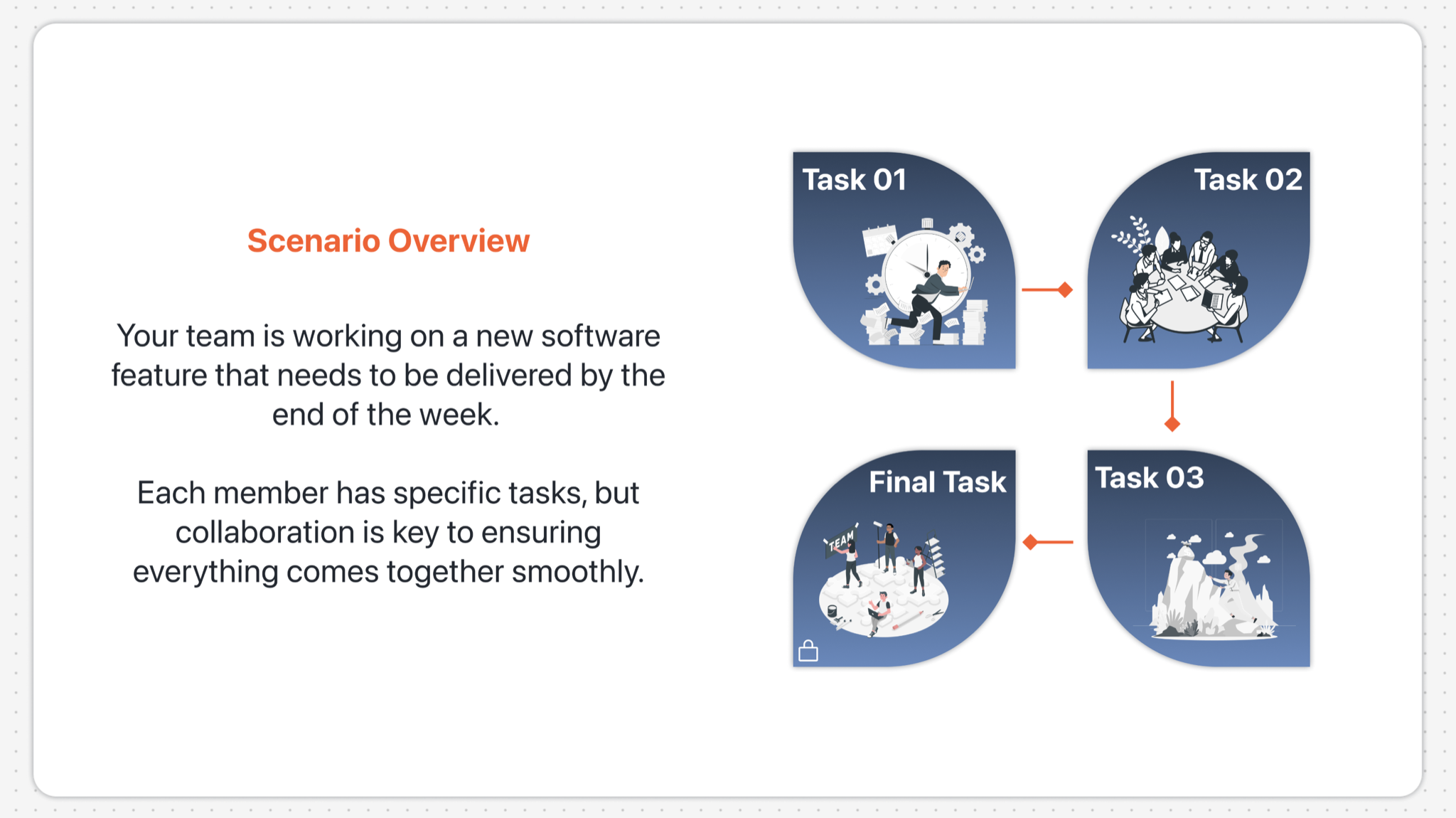
The scenario overview is a four-leaf menu with the last leaf visibly locked. Variables track each completed decision, and the final task only opens once the three are done. The lock is shown rather than hidden, so the learner can see the shape of the whole thing from the first screen.
Synthesis, not a score
The scenario closes with a card-flip task pulling the three decisions into one takeaway, each card tracked by its own variable. The learner assembles the principle themselves instead of reading it off a summary slide.
Walkthrough
Setup
"You're the newest team member at Innovatech, a leading tech company. Your first challenge? Collaborate effectively with your team on a critical project."
Meet Alex
Two screens introducing the team lead who will be available for hints throughout.
Scenario overview
A new software feature due by end of week; every member has their own tasks. Four-leaf menu with the final task locked.
Three decisions
Task 01 opens with a teammate struggling to meet their deadline. Each decision branches into a correct path, an incorrect path and an Alex-hint layer.
Final task
A three-card flip synthesising the takeaway, then a completion screen.
Build notes
- Seven Storyline variables gating decision completion and the locked final task.
- Hint layer available on every decision screen, independent of the correct/incorrect branches.
- Three-outcome branching on each decision rather than a binary right/wrong.
- Card-flip synthesis interaction with per-card completion tracking.
- Scenario UI and character framing designed in Figma.
Assessment
Formative throughout. Each decision returns consequence-based feedback rather than a mark, the hint system lets a learner recover before committing, and the gated final task confirms all three decisions were worked before the takeaway is assembled.