
Microlearning
Time Management
Seven modules on managing time as a remote worker, with a knowledge check closing every one.
Concept project — self-directed, built to a fictional client brief
- Articulate Rise 360
- Modules
- 7
- Lessons
- 22
- Knowledge checks
- 6
- Interactions
- 5
The brief
Time management advice is abundant and mostly useless, because it arrives as a list of named techniques with no indication of when to reach for which. The course's job isn't to introduce the Pomodoro technique — most learners have heard of it — it's to make the choice between methods concrete enough to act on.
Learning objectives
- Identify how remote work specifically erodes time, and what poor time management costs.
- Write goals that satisfy each element of the SMART framework.
- Select an appropriate prioritisation method for a given set of competing tasks.
- Build a time-blocked schedule and apply techniques for starting work you're avoiding.
- Apply four named techniques for protecting focus from distraction.
- Set boundaries that sustain work-life balance.
Design decisions
Name the remote-work problem first
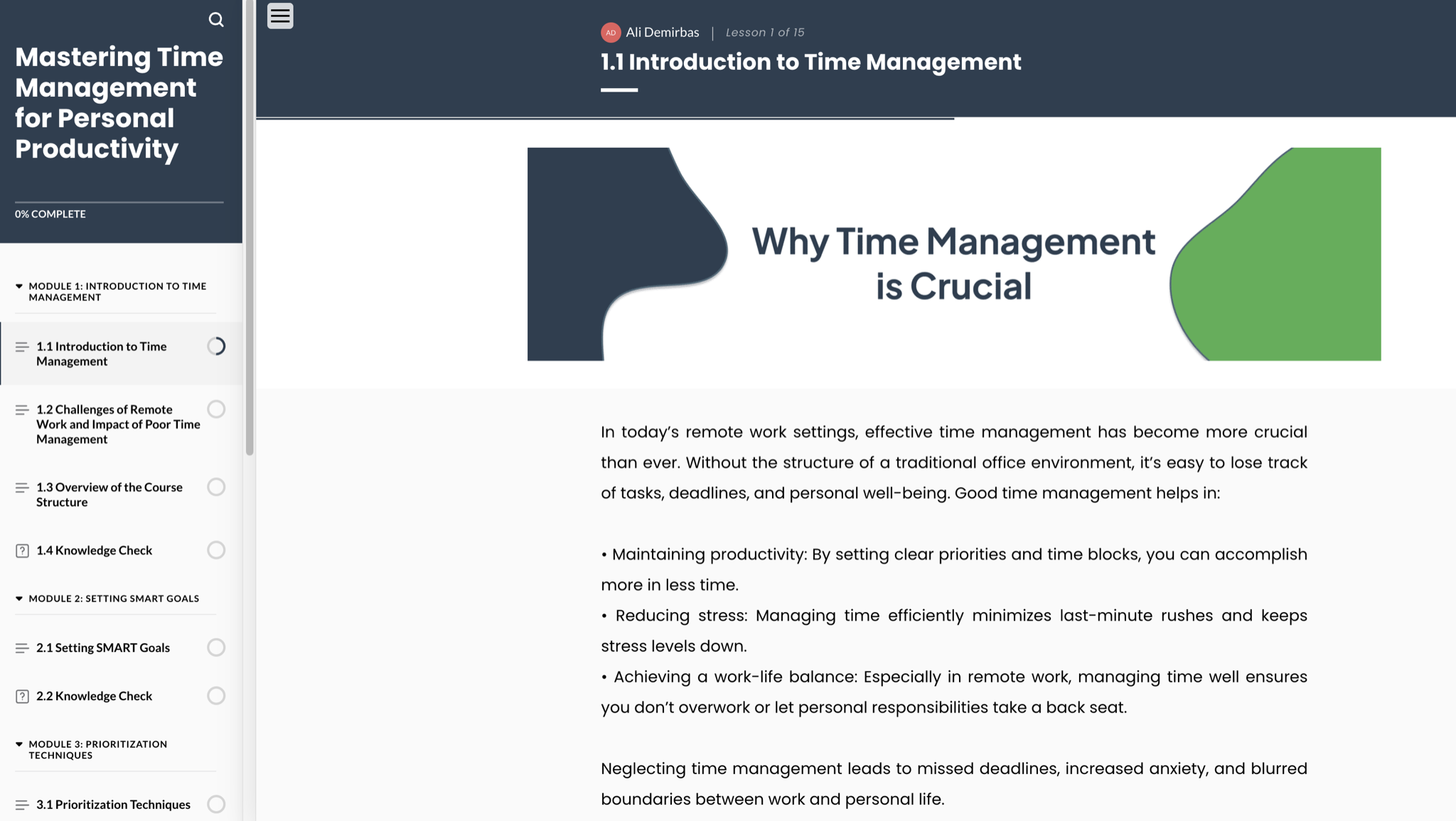
Module 1 doesn't open with the value of time management in the abstract — lesson 1.2 is "Challenges of Remote Work and Impact of Poor Time Management". Establishing the specific failure mode the learner recognises from their own week is what earns attention for the six modules that follow.
Match the interaction to the content's shape
SMART goals are an accordion, because the five elements are a checklist worked through in order. Prioritisation is tabs, because the Eisenhower Matrix, ABCDE, Eat the Frog and Pomodoro are parallel alternatives you compare. Managing distractions is a process block, because the four techniques build into a sequence. Same authoring tool, three different structures, each chosen for what the content actually is.
Knowledge checks that ask for a judgement
Six checks, one per module, and the strongest are scenario items rather than definition recall. Module 3's asks the learner to prioritise four competing real tasks — a report due tomorrow, unanswered email, next month's meeting, a messy desk — which is the actual skill. Module 2 gives a written goal and asks which SMART element it satisfies.
A check at every module boundary
Every module except the conclusion ends with a knowledge check, so no learner reaches module 5 uncertain whether module 3 landed. The regularity also breaks a long course into pieces short enough to finish in one sitting.
Walkthrough
1 · Introduction to Time Management
Framing, the remote-work problem, course structure, knowledge check.
2 · Setting SMART Goals
Five-part accordion through Specific, Measurable, Achievable, Relevant, Time-bound; two scenario-based check items.
3 · Prioritization Techniques
Four tabs comparing the Eisenhower Matrix, ABCDE Method, Eat the Frog and Pomodoro; check item asks the learner to prioritise a real task list.
4 · Time Blocking & Scheduling
Accordion covering task breakdown, the Two-Minute Rule, scheduling tools and completion rewards.
5 · Managing Distractions
Six-step process block — digital detox, focus-friendly workspace, Pomodoro, boundaries — plus a full-screen interaction and an image gallery.
6 · Work-Life Balance
Boundary-setting and sustaining balance, with a closing check.
7 · Conclusion and Next Steps
Consolidation and where to go next.
Build notes
- Seven modules / 22 lessons authored in Rise 360, responsive by default.
- Five distinct interaction types chosen per content structure: accordion, tabs, process, full-screen interactive, image gallery.
- Six multiple-choice knowledge checks, weighted toward application over recall.
- Consistent visual treatment with a supporting image on every lesson.
Assessment
Six knowledge checks, one per content module, all multiple choice. The better items present a situation and ask for a decision — prioritising a live task list, or judging which SMART element a written goal satisfies — rather than asking the learner to restate a definition.